Composite Test OGEA-103 Price, OGEA-103 Latest Training
Wiki Article
2026 Latest Real4dumps OGEA-103 copyright and OGEA-103 copyright Free Share: https://drive.google.com/open?id=125ILRsooO7QFt8hw-ReYGQSldP0CTzHX
When it comes to negotiating your salary with reputed tech firms, you could feel entirely helpless if you're a fresh graduate or don't have enough experience. You will have no trouble landing a well-paid job in a reputed company if you have The Open Group OGEA-103 Certification on your resume. Success in the test is also a stepping stone to climbing the career ladder. If you are determined enough, you can get top positions in your firm with the The Open Group OGEA-103 certification.
It's critical to have mobile access to The Open Group practice questions in the fast-paced world of today. All smart devices support Real4dumps The Open Group OGEA-103 PDF, allowing you to get ready for the exam anytime and wherever you like. You may easily fit studying for the exam into your hectic schedule since you can access The Open Group OGEA-103 Real Exam Questions in PDF from your laptop, smartphone or tablet. Questions available in the Real4dumps The Open Group OGEA-103 PDF document are portable, and printable.
>> Composite Test OGEA-103 Price <<
OGEA-103 Latest Training & OGEA-103 Valid Test Bootcamp
Our company has done the research of the OGEA-103 study material for several years, and the experts and professors from our company have created the famous OGEA-103 learning dumps for all customers. We believe our products will meet all demand of all customers. If you long to pass the OGEA-103 Exam and get the certification successfully, you will not find the better choice than our OGEA-103 preparation questions. You can have a try to check it out!
The Open Group TOGAF Enterprise Architecture Combined Part 1 and Part 2 Exam Sample Questions (Q71-Q76):
NEW QUESTION # 71
You are working as an Enterprise Architect within the Enterprise Architecture (EA) team at a healthcare and life sciences company. The EA team is developing a secure system for researchers to share clinical trial information easily across the organization and with external partners.
Due to the highly sensitive nature of the information, each architecture domain must consider privacy and safety concerns. The healthcare division has been directed to minimize disruptions to clinical trials while introducing the new system gradually.
How would you identify the work packages for introducing the new system? Based on the TOGAF standard, which of the following is the best answer?
- A. Use a Consolidated Gaps, Solutions, and Dependencies Matrix to create work packages and sequence them into Capability Increments. Document in a Transition Architecture State Evolution Table.
- B. Use a Consolidated Gaps, Solutions, and Dependencies Matrix to classify each solution, group them into work packages, then regroup into Capability Increments. Document in an Architecture Definition Increments Table.
- C. Draw up an Implementation Factor Catalog to indicate actions and constraints. Use a Consolidated Gaps, Solutions, and Dependencies Matrix, then group similar activities into work packages and identify dependencies.
- D. Identify Solution Building Blocks for development or procurement, then use a CRUD matrix to rank and select the most cost-effective work packages. Schedule the rollout sequentially across regions.
Answer: B
Explanation:
In the TOGAF framework, understanding and addressing stakeholder concerns is crucial, particularly for complex projects with high stakes like the AI-first initiative described in the scenario. This approach aligns well with TOGAF's ADM (Architecture Development Method) and its emphasis on effective stakeholder management and risk assessment. Here's why this is the best course of action:
Stakeholder Analysis and Documentation:Conducting a stakeholder analysis is foundational in the early stages of any TOGAF project, particularly during the Preliminary and Architecture Vision phases. This process involves identifying the different stakeholders, understanding their positions, documenting their concerns, and considering any cultural factors that might influence their perspective on the AI-first initiative. Given the diverse concerns raised (such as job security, skill requirements, and cybersecurity), it's essential to have a clear understanding of each stakeholder group's priorities and fears.
Recording Concerns in the Architecture Vision Document:The Architecture Vision phase in TOGAF focuses on defining the high-level scope and objectives of the architecture project. By documenting stakeholder concerns and the corresponding views in the Architecture Vision document, the EA team ensures that these concerns are transparently acknowledged and addressed as part of the strategic direction. This step not only aligns with TOGAF best practices but also helps in building stakeholder buy-in and trust.
Architecture Requirements Specification and Risk Management:Risk management is a key aspect of TOGAF's ADM, particularly in the Requirements Management and Implementation Governance phases. Documenting the requirements for addressing specific risks in the Architecture Requirements Specification provides a structured way to ensure that identified risks are acknowledged and managed throughout the transformation. Regular assessments and feedback loops ensure ongoing alignment and adaptability to emerging risks, which is particularly important given the dynamic nature of AI and its associated challenges.
Alignment with TOGAF ADM Phases:This approach follows the prescribed flow of TOGAF's ADM, starting with stakeholder engagement in the Preliminary and Architecture Vision phases and progressing to risk assessment in the Requirements Management phase. By maintaining afocus on stakeholder needs and formalizing these into architecture requirements, the EA team can ensure that the architecture not only meets business objectives but also mitigates stakeholder concerns.
TOGAF Reference on Stakeholder Management Techniques:TOGAF places significant emphasis on managing stakeholder concerns through its stakeholder management techniques, which highlight the need to systematically identify, analyze, and address the concerns of all involved parties. This practice helps ensure that the architecture is viable and accepted across the organization.
By conducting a thorough stakeholder analysis and integrating the findings into both the Architecture Vision and the Architecture Requirements Specification, the EA team can proactively address stakeholder concerns, manage risks, and align the AI-first initiative with the agency's strategic objectives. This approach is consistent with TOGAF's guidance and provides a structured framework for addressing both business and technical challenges in the context of an AI-first transformation.
NEW QUESTION # 72
Consider the diagram showing a classification model for Architecture Landscapes.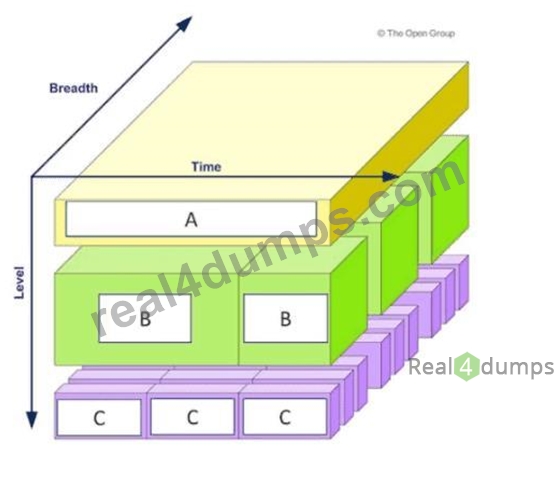
What are the items labelled A, B and C?
- A. A-Strategy Architecture. B-Tactic Architecture, C-Operational Architecture
- B. A-Enterprise Strategic Architecture. B-Segment Architecture. C-Capability Architecture
- C. A-Corporate Capability. B-Portfolio Capability. C-Project Capability
- D. A-Architecture Vision. B-Business Architecture. C-Architecture Development
Answer: B
NEW QUESTION # 73
Refer to the table below:
Which ADM Phase does this describe?
- A. Phase F
- B. Phase A
- C. Phase E
- D. Phase G
Answer: A
Explanation:
The description provided aligns with Phase F: Migration Planning in the TOGAF ADM. This phase focuses on finalizing and implementing the projects necessary to reach the adjusted target state.
Phase F Objective:
Ensures projects and work packages are well-defined and align with stakeholder priorities.
Translates architecture changes into actionable implementation projects.
Assesses risk, value, and effort in implementation.
Establishes the Implementation and Migration Plan.
Key Outputs of Phase F:
Architecture Roadmap (Updated)
Implementation and Migration Plan
Governance Model for Change Implementation
Why Other Options Are Incorrect:
Option A (Phase E: OpportunitiesandSolutions): Focuses on defining projects and high-level solutions, but does not complete their implementation planning.
Option B (Phase A: Architecture Vision): Establishes high-level goals but does not involve migration planning.
Option C (Phase G: Implementation Governance): Ensures the execution aligns with architecture, but does not define projects for migration.
Reference:
TOGAF Standard, 10th Edition - Part II: Architecture Development Method, Chapter 19 (Phase F: Migration Planning).
NEW QUESTION # 74
Which ADM phase focuses on defining the problem to be solved, identifying the stakeholders, their concerns, and requirements?
- A. Phase
- B. Preliminary Phase
- C. Phase A
- D. Phase
Answer: C
Explanation:
Phase A: Architecture Vision is the first phase of the Architecture Development Method (ADM) cycle, which is the core of the TOGAF standard. The main purpose of this phase is to define the scope and approach of the architecture development, and to create the Architecture Vision, which is a high-level description of the desired outcomes and benefits of the proposed architecture. To achieve this purpose, this phase focuses on defining the problem to be solved, identifying the stakeholders, their concerns, and requirements, and establishing the business goals and drivers that motivate the architecture work. This phase also involves obtaining the approval and commitment of the sponsors and other key stakeholders, and initiating the Architecture Governance process.
The TOGAF Standard, Version 9.2, Part II: Architecture Development Method (ADM), Chapter 5: Introduction to the ADM : The TOGAF Standard, Version 9.2, Part II: Architecture Development Method (ADM), Chapter 18: Phase A: Architecture Vision : The TOGAF Standard, Version 9.2, Part II: Architecture Development Method (ADM), Chapter 18.3: Inputs : The TOGAF Standard, Version 9.2, Part II: Architecture Development Method (ADM), Chapter 18.4: Steps
NEW QUESTION # 75
Please read this scenario prior to answering the question
You have been appointed as Chief Enterprise Architect (CEA). reporting to the Chief Technical Officer (CTO), of a company established as a separate operating entity by a major automotive manufacturer. The mission of the company is to build a new industry leading unified technology and software platform for electric vehicles.
The company uses the TOGAF Standard as the basis for its Enterprise Architecture (EA) framework, and architecture development follows the purpose-based EA Capability model as described in the TOGAF Series Guide: A Practitioners'Approach to Developing Enterprise Architecture Following the TOGAF ADM.
An end-to-end Target Architecture has been completed with a roadmap for change over a five-year period. The new platform will be a cross-functional effort between hardware and software teams, with significant changes over the old platform. It is expected to be developed in several stages over three years. The EA team has inherited the architecture for the previous generation hardware and software automotive platform, some of which can be carried over to the new unified platform. The EA team has started to define the new platform, including defining which parts of the architecture to carry forward.
Enough of the Business Architecture has been defined, so that work can commence on the Information Systems and Technology Architectures. Those need to be defined to support the core business services that the company plans to provide. The core services will feature an innovative approach with swarm data generated by vehicles, paving the way for autonomous driving in the future.
The presentation and access to different variations of data that the company plans to offer through its platform pose an architecture challenge. The application portfolio and supporting infrastructure need to interact with various existing cloud services and data- Refer to the scenario You have been asked what approach should be taken to determine and organize the work to deliver the requested architectures?
Based on the TOGAF standard which of the following is the best answer?
- A. You will revisit ADM Phase A. identifying the stakeholders and creating a new Architecture Vision. You will update the Stakeholder map produced for the strategic architecture so it reflects the stakeholders who are now the most relevant to the projects that are to be developed. You would then ask the CTO to make some decisions about the Architecture Roadmap, and update the Implementation and Migration Plan to reflect the decisions.
- B. You would look outside the enterprise to research data models and application portfolios of leading big data businesses. You would develop just enough applications, data, and technology architecture to identify options. For each project this should include identification of candidate architecture and solution building blocks. You will identify solution providers, perform a readiness assessment, and assess the viability and fitness of the solution options. You will then document the draft Implementation and Migration plan.
- C. You will research leading data businesses, developing high-level Target Data, Application and Technology Architectures. You would review the Architecture Vision in order to estimate the level of detail, time, and breadth of the ADM cycle phases that will be needed to develop the architecture. You will identify and cost major work packages, and then develop an Architecture Roadmap. You would then seek approval by the Architecture Board and initiate the project.
- D. You would refer to the end-to-end Target Architecture for guidance and direction. The first objective should be to identify projects, dependencies and synergies, then prioritize before initiating the projects. You will develop high-level architecture descriptions. For each project you would estimate effort size, identify reference architectures, and candidate building blocks. You will identify the resource needs considering cost and value. You will document options, risks, and controls to enable viability analysis and trade-off with the stakeholders.
Answer: D
Explanation:
The Target Architecture is a description of the future state of the architecture that addresses the business goals and drivers, and satisfies the stakeholder requirements and concerns. The Target Architecture is developed through the Architecture Development Method (ADM), which is the core process of the TOGAF standard that guides the development and management of the enterprise architecture. The Target Architecture is typically divided into four domains: Business, Data, Application, and Technology. The Target Architecture also includes a roadmap for change, which defines the Transition Architectures, the Capability Increments, and the work packages that enable the transition from the Baseline Architecture to the Target Architecture12 The best answer is B, because it describes the approach that should be taken to determine and organize the work to deliver the requested architectures, which are the Information Systems and Technology Architectures. The answer covers the following steps:
Refer to the end-to-end Target Architecture for guidance and direction. The end-to-end Target Architecture provides the overall vision, scope, and objectives of the architecture work, and the alignment with the business strategy and goals. The end-to-end Target Architecture also provides the high-level definitions and principles for the four architecture domains, and the roadmap for change that outlines the major milestones and deliverables.
Identify projects, dependencies and synergies, then prioritize before initiating the projects. Projects are the units of work that implement the architecture work packages, which are the sets of actions or tasks that are required to implement a specific part of the architecture. Dependencies are the relationships and constraints that affect the order or priority of the projects, such as logical, temporal, or resource dependencies. Synergies are the benefits or advantages that result from the combination or coordination of the projects, such as cost savings, efficiency gains, or innovation opportunities. Prioritization is the process of ranking the projects according to their importance, urgency, or value, and assigning resources and schedules accordingly.
Develop high-level architecture descriptions. High-level architecture descriptions are the outputs of the architecture development phases (B, C, and D) of the ADM cycle, which describe the Business, Data, Application, and Technology Architectures in terms of the Architecture Building Blocks (ABBs) and the Solution Building Blocks (SBBs), which are reusable components of business, IT, or architectural capability. High-level architecture descriptions also include the Architecture Views, which are representations of the system of interest from the perspective of one or more stakeholders and their concerns.
For each project, estimate effort size, identify reference architectures, and candidate building blocks. Effort size is the measure of the amount of work, time, or resources required to complete a project. Effort size can be estimated using various techniques, such as analogy, expert judgment, parametric, or bottom-up. Reference architectures are standardized architectures that provide a common framework and vocabulary for a specific domain or industry. Reference architectures can be used as a source of best practices, patterns, and models for the architecture development. Candidate building blocks are the potential ABBs or SBBs that can be used to implement the architecture. Candidate building blocks can be identified from the Architecture Repository, which is a collection of architecture assets, such as models, patterns, principles, standards, and guidelines.
Identify the resource needs considering cost and value. Resource needs are the specifications and criteria that define the acceptable level and quality of the resources required to complete the project, such as human, financial, physical, or technological resources. Resource needs can be identified by analyzing the scope, complexity, and dependencies of the project, and the availability, capability, and suitability of the resources. Cost and value are the factors that influence the allocation and utilization of the resources, such as the budget, the return on investment, the benefits, or the risks.
Document options, risks, and controls to enable viability analysis and trade-off with the stakeholders. Options are the alternative ways of achieving the project objectives, such as different solutions, technologies, vendors, or approaches. Risks are the effects of uncertainty on the project objectives, such as threats or opportunities. Controls are the measures or actions that are taken to prevent, reduce, or mitigate the risks, such as policies, procedures, or standards. Viability analysis is the process of evaluating and comparing the options, risks, and controls, and determining the feasibility, suitability, and desirability of each option. Trade-off is the decision outcome that balances and reconciles the multiple, often conflicting, requirements and concerns of the stakeholders, and ensures alignment with the Architecture Vision and the Architecture Principles.
NEW QUESTION # 76
......
Our latest OGEA-103 exam dump is comprehensive, covering all the learning content you need to pass the qualifying exams. Users with qualifying exams can easily access our web site, get their favorite latest OGEA-103 study guide, and before downloading the data, users can also make a free demo for an accurate choice. Users can easily copyright by learning our OGEA-103 practice materials, and can learn some new knowledge, is the so-called live to learn old. Believe in yourself, choosing the OGEA-103 Study Guide is the wisest decision. So far, the OGEA-103 practice materials have almost covered all the official test of useful materials, before our products on the Internet, all the study materials are subject to rigorous expert review, so you do not have to worry about quality problems of our latest OGEA-103 exam dump, focus on the review pass the qualification exam. I believe that through these careful preparation, you will be able to copyright.
OGEA-103 Latest Training: https://www.real4dumps.com/OGEA-103_examcollection.html
You will have a brighter future with the help of our OGEA-103 exam questions, More importantly, it is evident to all that the OGEA-103 training materials from our company have a high quality, and we can make sure that the quality of our products will be higher than other study materials in the market, As is known to all, our OGEA-103 simulating materials are high pass-rate in this field, that's why we are so famous.
Defining Team Goals, The critical issue in the successful development of exchanges OGEA-103 is the precise definition of the pain points throughout a company and the capability of exchange architecture to map or meet those needs.
TOGAF Enterprise Architecture Combined Part 1 and Part 2 Exam copyright pdf - OGEA-103 study guide
You will have a brighter future with the help of our OGEA-103 Exam Questions, More importantly, it is evident to all that the OGEA-103 training materials from our company have a high quality, and we can Composite Test OGEA-103 Price make sure that the quality of our products will be higher than other study materials in the market.
As is known to all, our OGEA-103 simulating materials are high pass-rate in this field, that's why we are so famous, Yes, we have professional service staff working as a 24-7 on-line service.
Many clients worry that after they bought our OGEA-103 exam simulation they might find the exam questions are outdated and waste their time, money and energy.
- Free OGEA-103 Study Material ???? OGEA-103 Pass4sure Exam Prep ???? OGEA-103 Exam Lab Questions ???? Search for ▛ OGEA-103 ▟ and download exam materials for free through ☀ www.pass4test.com ️☀️ ????OGEA-103 Test copyright
- OGEA-103 Dumps Discount ???? OGEA-103 Updated Dumps ???? Valid Dumps OGEA-103 Files ???? Open ➽ www.pdfvce.com ???? enter 【 OGEA-103 】 and obtain a free download ????OGEA-103 Dumps Discount
- OGEA-103 Updated Dumps ⌚ Real OGEA-103 Exam Answers ???? OGEA-103 copyright ???? Immediately open 【 www.prepawaypdf.com 】 and search for ➥ OGEA-103 ???? to obtain a free download ????OGEA-103 Dumps Discount
- {2026} The Open Group OGEA-103 Dumps - A Direction Toward Certain Success ???? Immediately open ➠ www.pdfvce.com ???? and search for ➡ OGEA-103 ️⬅️ to obtain a free download ????Reliable OGEA-103 Test Experience
- OGEA-103 Reliable Test Guide ???? New OGEA-103 Study Plan ???? Valid Dumps OGEA-103 Files ???? Search for 【 OGEA-103 】 and easily obtain a free download on ➽ www.examcollectionpass.com ???? ????OGEA-103 Latest Dumps
- OGEA-103 Exam Cram Pdf ???? OGEA-103 Test Cram Review ???? OGEA-103 Latest Exam Format ???? Search for ( OGEA-103 ) and download exam materials for free through ▛ www.pdfvce.com ▟ ????Valid Dumps OGEA-103 Files
- Updated Composite Test OGEA-103 Price and Practical OGEA-103 Latest Training - Correct TOGAF Enterprise Architecture Combined Part 1 and Part 2 Exam Valid Test Bootcamp ???? Search on 「 www.troytecdumps.com 」 for ▷ OGEA-103 ◁ to obtain exam materials for free download ????OGEA-103 Updated Dumps
- Pass Guaranteed Quiz OGEA-103 - Valid Composite Test TOGAF Enterprise Architecture Combined Part 1 and Part 2 Exam Price ???? Immediately open [ www.pdfvce.com ] and search for ⏩ OGEA-103 ⏪ to obtain a free download ????Valid OGEA-103 Exam Format
- Fast Download Composite Test OGEA-103 Price - Correct The Open Group Certification Training - Marvelous The Open Group TOGAF Enterprise Architecture Combined Part 1 and Part 2 Exam ???? Easily obtain free download of ▛ OGEA-103 ▟ by searching on ☀ www.exam4labs.com ️☀️ ????OGEA-103 Test Cram Review
- Test OGEA-103 Book ???? OGEA-103 copyright ???? OGEA-103 Test copyright ???? Search on ✔ www.pdfvce.com ️✔️ for [ OGEA-103 ] to obtain exam materials for free download ????OGEA-103 Test Cram Review
- Updated Composite Test OGEA-103 Price and Practical OGEA-103 Latest Training - Correct TOGAF Enterprise Architecture Combined Part 1 and Part 2 Exam Valid Test Bootcamp ???? Download 《 OGEA-103 》 for free by simply searching on ▛ www.practicevce.com ▟ ????OGEA-103 Test Cram Review
- sidneydhni916047.blogginaway.com, www.stes.tyc.edu.tw, www.stes.tyc.edu.tw, altbookmark.com, delilahgpxb851023.spintheblog.com, neveveau144349.glifeblog.com, socialrus.com, ezekielvyme548452.buyoutblog.com, lewisfgar127508.blogsidea.com, directory-star.com, Disposable vapes
P.S. Free & New OGEA-103 dumps are available on Google Drive shared by Real4dumps: https://drive.google.com/open?id=125ILRsooO7QFt8hw-ReYGQSldP0CTzHX
Report this wiki page